Published on November 2, 2026
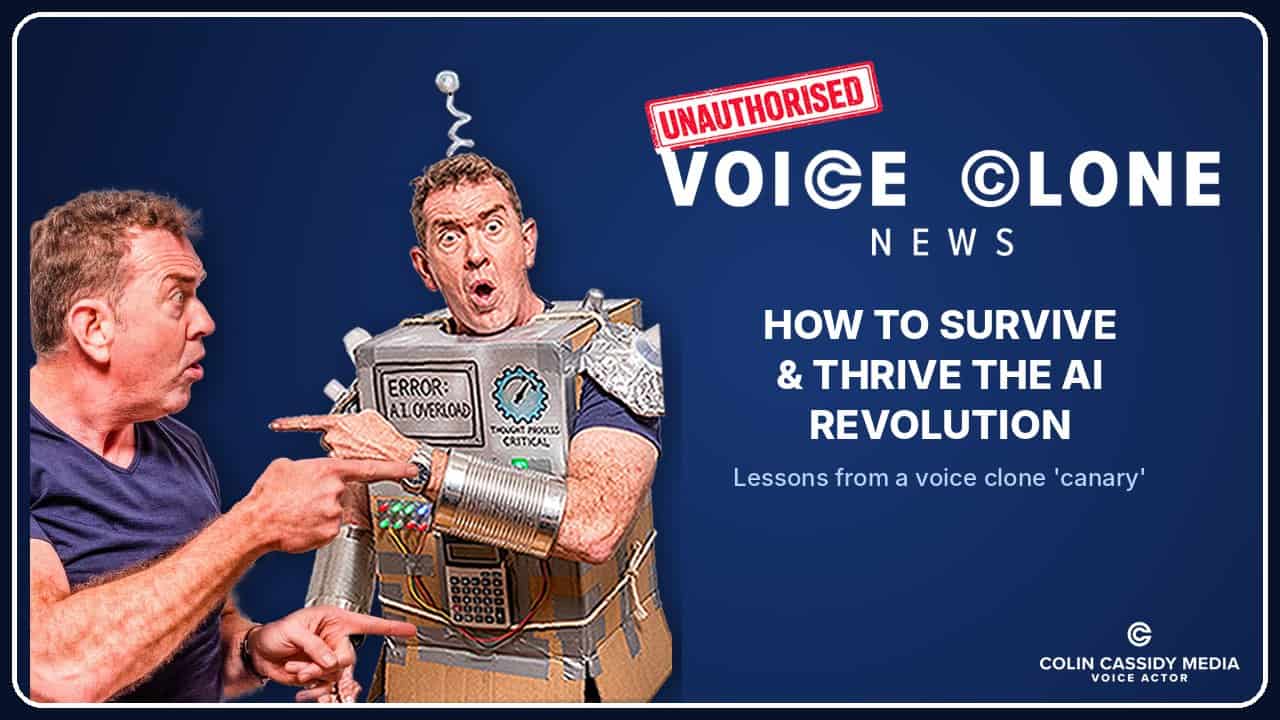
How to survive and thrive in the approaching AI tsunami, from someone who has already been hit by the first wave. Up the humans!
You’re probably not used to a voice actor handing out advice on surviving AI. But I’ve spent the last while as a “voice clone theft canary” in the proverbial AI mine, and what I’ve learned is too useful to keep to myself. So these tips are on me.
I’ve been voicing since 1993. For more than 30 years, world-class content has always relied on humans collaborating with humans, with nary a robot in sight. Until now.
Getting quality work written, approved, funded, cast, filmed, recorded, produced, signed off and on air has never been easy. I’ve even enjoyed the odd spectacle of a passionate fight over an idea or a strapline. But one thing has always been central: brilliant producers and creatives leading a human team to weave their intangible, often emotive, magic.
Are those partnerships about to be disrupted, or even reimagined? As the AI tsunami hits the creative industry, the air is thick with fear and energy-sapping speculation. It’s a crazy time.
So let me encourage you with some hard-won advice. These tips come from my own recent experience in the murky AI trenches. But look closely, and there’s gold.
1. Get curious, fast
Being the resident canary has put me through a few wringers. But wow, what it’s taught me is game-changing.
Once the amygdala hijack wears off, the sooner you get into curiosity mode, the better. Learn everything you can. You’ll find questions that don’t have answers yet, and hidden in those questions are the possibilities that will shape the future.
The big one I keep coming back to: what will the premium end, the high ground, of our business look like as this industrial revolution kicks in? Or, as an account manager I once worked with put it, “But who’s got the money?”
Where will AI find its sweet spot, and where will we humans find ours? And will the old adage “people buy from people” still hold true?
2. Make the perspective shift
Small observations can lead to profound shifts in perspective. Here’s the one that changed my career.
I was in a session, looking through the glass, thinking the script would work so much better if one sentence were flipped and a repeated word removed. I remembered some coaching from years-old management training, and instead of staying quiet, I asked: “Folks, could I have your permission to suggest a few things about the script?”
The room fell silent, as if I’d dropped an F-bomb. Then the executive creative director leaned over, tapped the senior writer on the arm and whispered something along the lines of, “Let him. This is what he does.” I made my case, tying it back to the brand values, the character, tighter word economy and a synonym that kept the humour. They barely blinked: “Love it. Let’s do it.”
It took me years to go from timid “just do what you’re told” to a friendly, consultative bear, secure enough to take a risk that could make the work better, even if it gets knocked back. I’d had those capabilities all along. I just lacked the confidence to use them. Ironically, I was so passionate about my craft that I’d become paranoid about blowing an opportunity, and that fear was suppressing the very ideas that made me valuable.
I’m not there just to be paid. I’m there to serve: to make people feel it, buy it and love it, to polish and collaborate, and to bring out the best in the team. Never with ego, and always with permission and courtesy.
On bad days, I used to complain to my agent that I’d had to rewrite the script, calm the client down and ask the engineer to put back a consonant he’d chopped off. My agent reminded me that few others were adding that kind of value, and word was getting around. Those calls changed to: “What a buzz. I added more than they’d hoped for, and the whole team found even better ideas as we worked the problem.”
That’s the shift: my value is more than the voice, and that’s why clients book me again. It’s now part of the casting brief on other projects, which I love. As my Scottish mother would say, all I needed was a wee knuckle o’er the heid to bring me to my senses.
3. Rediscover your hidden value
We all need to hybridise and perfect the art of the pivot. Some people will retrain entirely and move to pastures new. But as we each run a SWOT on our skills, many will discover that the value they’ve always offered is now rarer, and more sought after, than ever.
Think of the scene in Forrest Gump where Forrest and Lieutenant Dan return to shore after a hurricane. Every rival shrimp boat has been wrecked, theirs is the only one left, and they corner the market. What once seemed ordinary suddenly becomes priceless.
4. Is it happening to you, or for you?
In the middle of our AI-induced hurricanes, there’s never been a better time to remember that change can happen to you, or for you. It’s the same shift as moving from “I have to go to work” to “I get to go to work.”
My voice clone theft has taken me on exactly that journey. I now say my voice is so valuable that I was one of the first the clone thieves targeted. There are lots of recipes for lemons.
5. Find your rare shrimp mojo
When you rediscover your hidden “shrimp mojo”, it can become your USP, especially when the market suddenly runs short of it. New tools can even amplify it, or unlock superpowers that have been lying dormant. Boom! Shake the room. (Only the 90s kids will get that one. Sorry.)
6. Harness your intangible value
My mojo is helping producers pivot fast when stakeholders change the brief mid-session: to a lighter read, say, or whatever else is in my wheelhouse. It’s squeezing in a lightning-fast disclaimer to fit an extra USP, or landing the one emotive inflection that hits the target.
I’ve watched creatives’ faces light up when I improvise off their idea and the room ignites. Or when, on deadline, a producer needs takes that are faster but sound slower, with a touch of wry.
7. Engage your emotional radar
Who’d have thought that raising children with autism, ADHD and significant neurological challenges would prepare me so well as a voice actor? It taught me to read the room and pick up on a tell. That shapes how I bring a client or team member into acceptance, play and alignment, so we make great work without the egos, on time and beyond expectations.
8. Pivot from human doing to human being
Whether you’re a producer, a leader, a creative or a humble voice artist, it’s empowering to realise you’re far more than what’s written on the tin. We can rediscover our human being, and stop being merely a human doing.
9. Strategic partners are key
Unless your approach is to do the minimum, take the money and run, you’ll care about the customer experience, whatever your role. If I’m doing the bare minimum for a client, it’s because I haven’t found a way to add value yet. That’s low investment from me and low return for them: purely tactical. Sometimes that’s all a client will allow, because they don’t know what they don’t know. But you won’t find out unless you push, and judging that calculated risk is both the danger and the fun.
When I find a way to offer more, through intuition, questions, raw talent, improvisation or active listening, the game shifts from tactical to strategic: more investment from me, more return for the client. A quick, cheap tactical win is a sprint. An engaged, value-adding partnership is a marathon, but far less exhausting than a million one-off sprints.
So my pitch to casting directors, producers and creatives is simple. Cast me and you get more than a voice: a human being first, then the human doing. Why settle for a one-off transactional hire when you can build a strategic partnership, an instant addition to your team? That’s what I love about the agency and client teams I’m privileged to work with.
10. Bring a servant attitude
Clients often comment on this intangible value, and I try hard to dampen my Aussie self-deprecation when they do. I’m told I’m quirky, highly relational, consultative and good at reading the room. From my voices, accents and impressions to my background as a creative director, writer, people manager and account director, or just the timbre of my voice, I walk into every session there to serve. And that’s what fills my cup.
Here’s to finding our voice
The AI wave is real, but so is the value only humans bring to the room. Get curious, shift your perspective, and go looking for the mojo you didn’t know you had.
If you’re a producer, creative or casting director who wants more than just a voice on your next project, I’d love to hear from you. Book through EM Voices (alex@emvoices.com.au) in Australia (02 9369 5700), or get in touch for international work.
Up the humans!
Colin